Research·
Vocabulary Specialization Cuts SLM Inference Cost by 77%
Dharma-AI's VocabX method rebuilds tokenizers around token cost rather than frequency, slashing inference expenses for domain-specific small language models without retraining the base model.
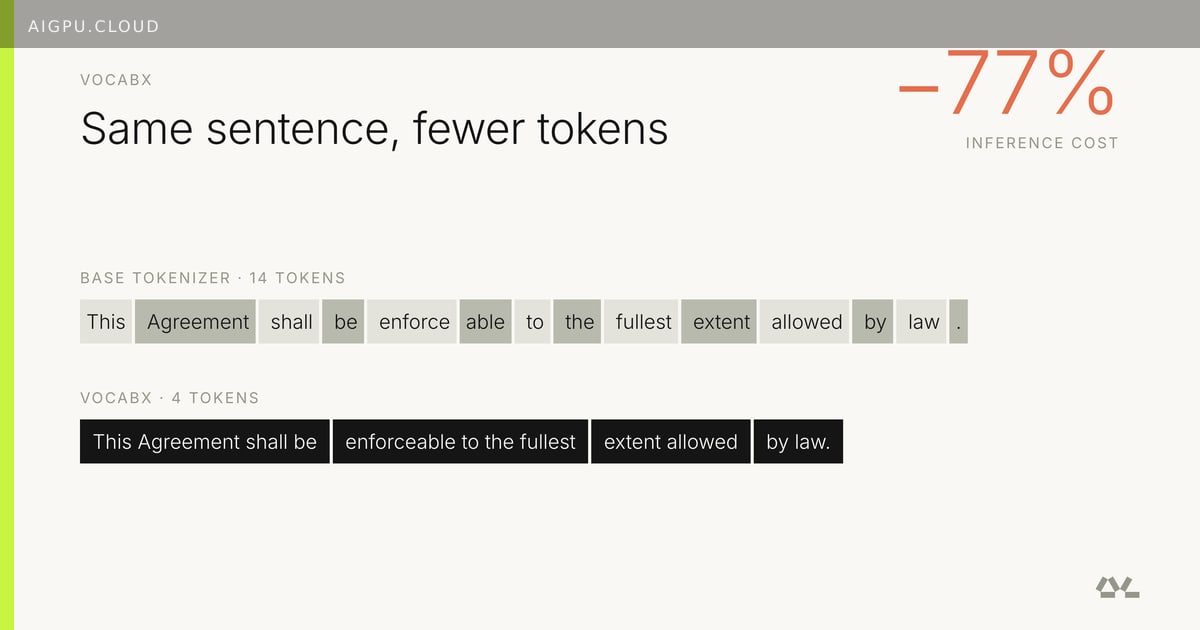
Small language models fine-tuned for a single domain often inherit a general-purpose tokenizer that inflates inference costs in two ways. First, the tokenizer fragments recurring domain patterns — JSON envelopes, boilerplate clauses, or code identifiers — into many tokens where one would suffice. Second, the model computes probabilities for tens of thousands of vocabulary entries it will never use, such as Chinese characters when grading Portuguese essays.
VocabX: Cost-Aware Vocabulary Design
The Dharma-AI team introduced VocabX, a method that rebuilds the vocabulary around the measured cost of each token rather than its raw frequency. Applied to a Qwen3-4B Portuguese essay grader, the specialized tokenizer reduced the vocabulary from 151,669 entries to a domain-focused subset while keeping the base model, training data, and recipe unchanged. Measured inference cost dropped 77% in production.
For GPU cloud operators and AI infrastructure teams, this result highlights a frequently overlooked lever: tokenizer optimization before any training step. A smaller, domain-aligned vocabulary reduces both token generation overhead and the final-layer matrix multiplication at every decoding step, directly lowering GPU hours per request.
- aigpu
- ai gpu
- ai gpu cloud
- aigpu dubai
- vocabx
- tokenizer optimization
- slm inference
- gpu cost reduction
By AiGpu Editorial · Editorial rewrite based on public reporting (Hugging Face Blog)
← All articles