Models·
NVIDIA and UW Release RFD4-Proteina: Unified Protein Design Model Now Accessible on Hugging Face Spaces
A new open model from NVIDIA and the University of Washington's Institute for Protein Design merges sequence and all-atom structure generation into a single flow-matching pipeline, runnable in-browser on dedicated RTX PRO 6000 GPUs.
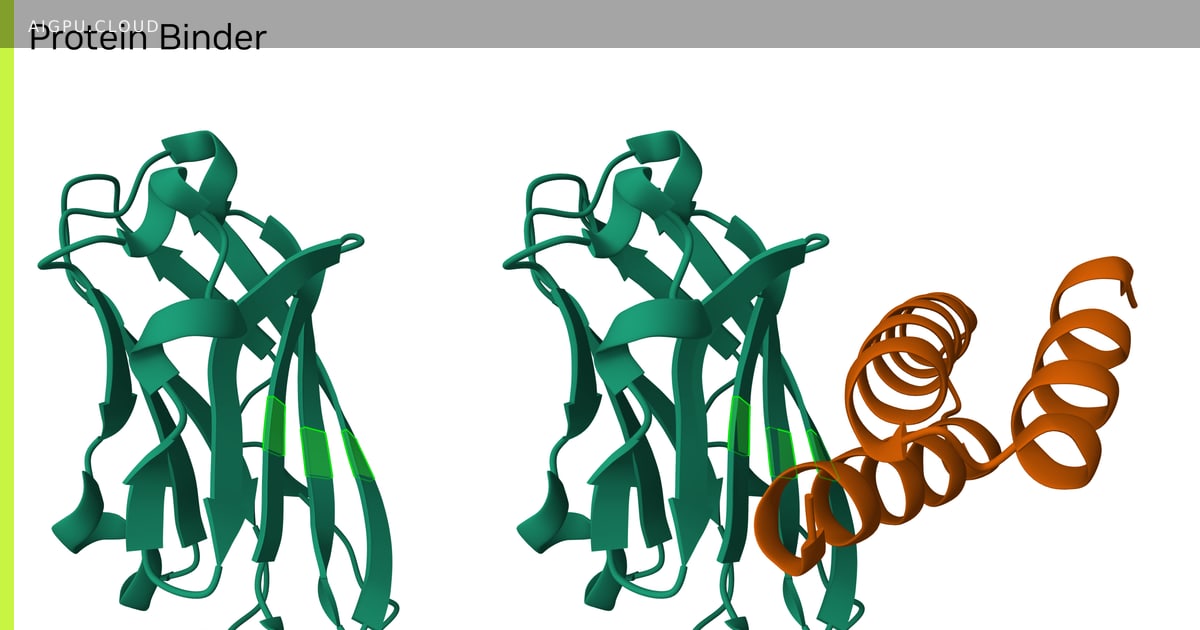
Protein design workflows have traditionally fragmented across specialized models for backbone generation, sequence design, and all-atom refinement, losing information at each handoff. RFD4-Proteina, co-developed by NVIDIA and the University of Washington's Institute for Protein Design, consolidates these stages into a single BioNeMo open model. It pairs a flow-matching generator with a learned autoencoder that represents every amino acid, nucleotide, sugar, metal ion, and modified residue as an anchor coordinate plus a latent chemical-identity vector, enabling joint sequence-and-structure synthesis around user-specified constraints such as binding hotspots or catalytic motifs.
The model accepts molecular contexts that include proteins, small molecules, nucleic acids, glycans, and post-translationally modified residues, making it suitable for binder design, enzyme engineering, and multi-component assembly tasks. Users can experiment immediately through two Hugging Face Spaces: a dedicated instance backed by NVIDIA RTX PRO 6000 GPUs and a shared ZeroGPU instance. From 21 October to 4 November 2026, NVIDIA is sponsoring free access to the dedicated Space, which also integrates AtomWorks Studio for interactive structure inspection and annotation.
Why it matters for GPU and AI infrastructure
RFD4-Proteina demonstrates how large-scale generative biology models demand high-memory, high-throughput GPUs for interactive inference. The dedicated Space runs on RTX PRO 6000 cards with 48 GB VRAM, highlighting the hardware profile needed for production protein-design workloads. For teams building internal pipelines, the model's open weights and containerized deployment path via BioNeMo Framework translate directly to on-premises or cloud GPU clusters, reducing time-to-insight for therapeutic and industrial enzyme programs.
- aigpu
- ai gpu
- ai gpu cloud
- aigpu dubai
- protein-design
- generative-ai
- nvidia
- biomemo
By AiGpu Editorial · Editorial rewrite based on public reporting (Hugging Face Blog)
← All articles