Infrastructure·
Training Microduck in Simulation and Deploying on Real Hardware with Isaac Lab 3.0
A new open‑source bipedal robot, Microduck, can now be trained to walk in NVIDIA Isaac Lab’s GPU‑parallel simulation, exported as ONNX, and run on the physical platform.
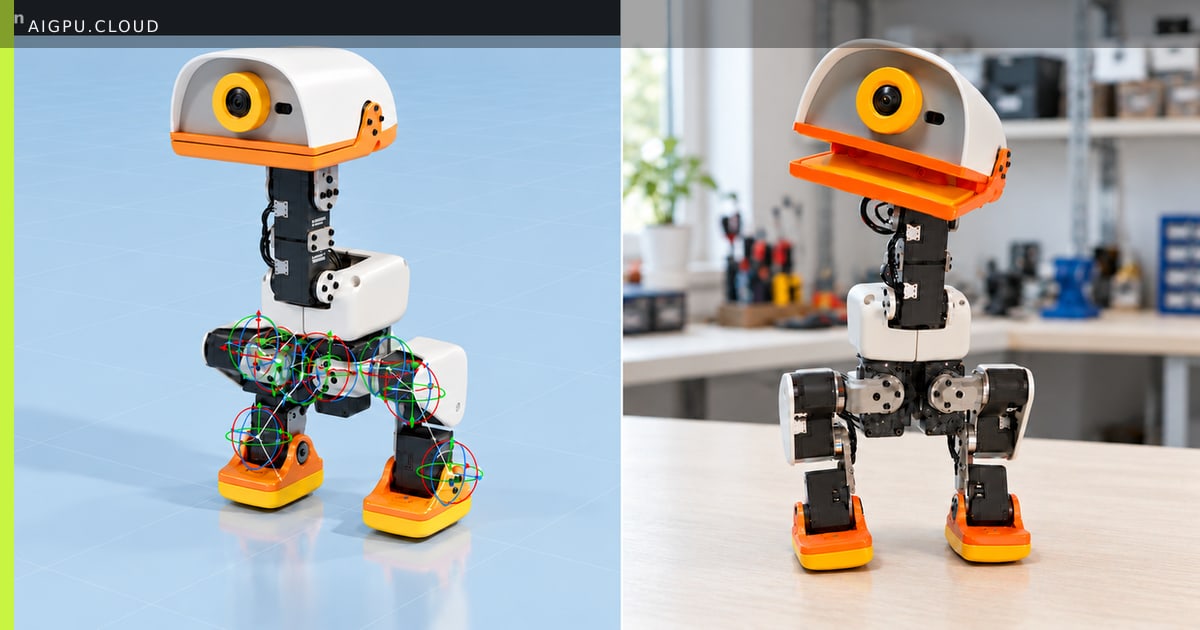
Microduck, an affordable open‑source bipedal robot from Pollen Robotics and Hugging Face, now integrates directly with NVIDIA Isaac Lab 3.0. Developers can train a walking policy across thousands of GPU‑parallel environments, apply domain randomization and Newton actuator modeling, then export the trained network as an ONNX file for deployment on the real robot.
Key steps in the workflow
- Install Isaac Lab on a Linux workstation equipped with a supported NVIDIA GPU and the uv package manager.
- Verify the Microduck task presets are available and inspect the observation‑action space (61 inputs, 14 joint‑position outputs).
- Launch distributed training across multiple GPUs to accelerate convergence.
- Export the policy to ONNX, validate it in Microduck Arena, and run it on the physical hardware using a paired gamepad.
Why it matters for GPU / AI infrastructure: The pipeline demonstrates how large‑scale GPU simulation reduces the sim‑to‑real gap for legged locomotion, turning a research‑grade workflow into a repeatable, hardware‑agnostic process that can be hosted on cloud GPU clusters.
By sharing trained policies on the Hugging Face Hub, teams can benchmark, iterate, and collaborate on increasingly complex tasks such as stair climbing or uneven terrain navigation, all powered by the same GPU‑accelerated simulation stack.
- aigpu
- ai gpu
- ai gpu cloud
- aigpu dubai
- isaac lab
- simulation
- robotics
- onnx
By AiGpu Editorial · Editorial rewrite based on public reporting (Hugging Face Blog)
← All articles