Models·
Accelerating Vision-Language Models with LFM2.5-VL-DSpark
LiquidAI has introduced LFM2.5-VL-DSpark, an experimental draft model designed to significantly accelerate vision-language models (VLMs) through speculative decoding. This innovation promises faster inference without compromising output quality, making advanced AI more accessible and efficient.
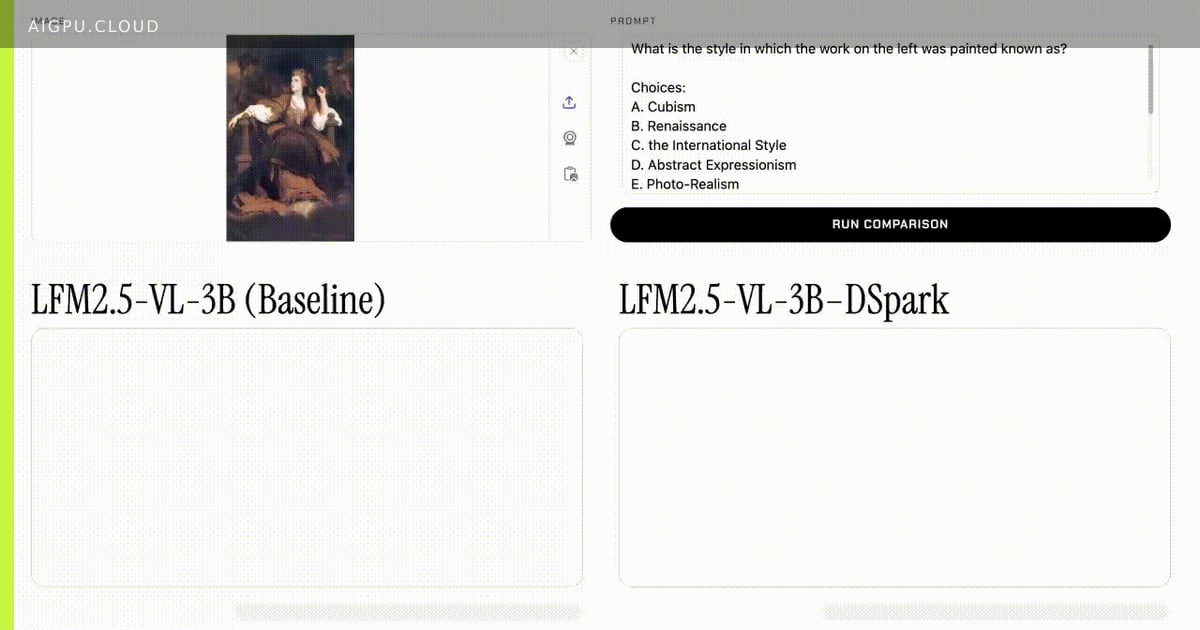
LiquidAI Unveils LFM2.5-VL-DSpark for Enhanced VLM Performance
LiquidAI has announced the release of LFM2.5-VL-DSpark, an experimental draft model aimed at dramatically improving the inference speed of their LFM2.5-VL-3B vision-language model. This new development leverages speculative decoding, a technique that introduces a secondary, smaller model (the drafter) to predict upcoming tokens, which are then verified by the main model. This method allows for substantial speedups while maintaining the original model's output fidelity.
The LFM2.5-VL-DSpark drafter, with approximately 280 million parameters, represents a modest 8.9% increase in the total parameter count. Despite this minimal overhead, the performance gains are significant. Benchmarking on an H100 GPU demonstrated decoding speedups of up to 2.66x, with end-to-end inference improvements reaching 2.27x. On edge devices like the M5 Max, decoding speeds saw an uplift of up to 3.13x, and end-to-end latency improved by up to 2.62x.
A key aspect of this innovation is its broad compatibility. LiquidAI has ensured day-one support for popular inference frameworks, including llama.cpp, MLX-VLM, and SGLang. This integration simplifies deployment and allows developers to immediately capitalize on the accelerated performance across various hardware configurations, from data center GPUs to consumer-grade devices.
While speculative decoding offers considerable advantages for the decoding phase, its impact on overall VLM performance can be constrained by other computational bottlenecks. Specifically, the initial vision encoding and prefill stages, which can be compute-intensive, especially on edge devices, are not directly accelerated by this method. Consequently, the end-to-end speedup is subject to Amdahl's Law, meaning the overall improvement is limited by the unaccelerated portions of the workflow.
Why it matters for GPU / AI infrastructure
This advancement is crucial for GPU and AI infrastructure providers. Faster inference directly translates to higher throughput and lower operational costs for deploying large-scale AI models. For GPU cloud platforms, optimizing VLM performance means more efficient utilization of expensive hardware like the H100, enabling clients to run more complex tasks or serve more users with the same resources. Furthermore, the focus on compatibility with diverse frameworks underscores the need for flexible and high-performance infrastructure that can seamlessly integrate with the latest AI acceleration techniques.
- aigpu
- ai gpu
- ai gpu cloud
- aigpu dubai
- vision-language models
- speculative decoding
- gpu acceleration
- ai inference
- h100
- edge ai
By AiGpu Editorial · Editorial rewrite based on public reporting (Hugging Face Blog)
← All articles