Industry·
Korea Accelerates Physical AI Across Manufacturing, Mobility and Robotics
South Korea's industrial leaders are deploying NVIDIA accelerated computing to bring physical AI from research into production, spanning semiconductor engineering, autonomous driving and robotic manipulation.
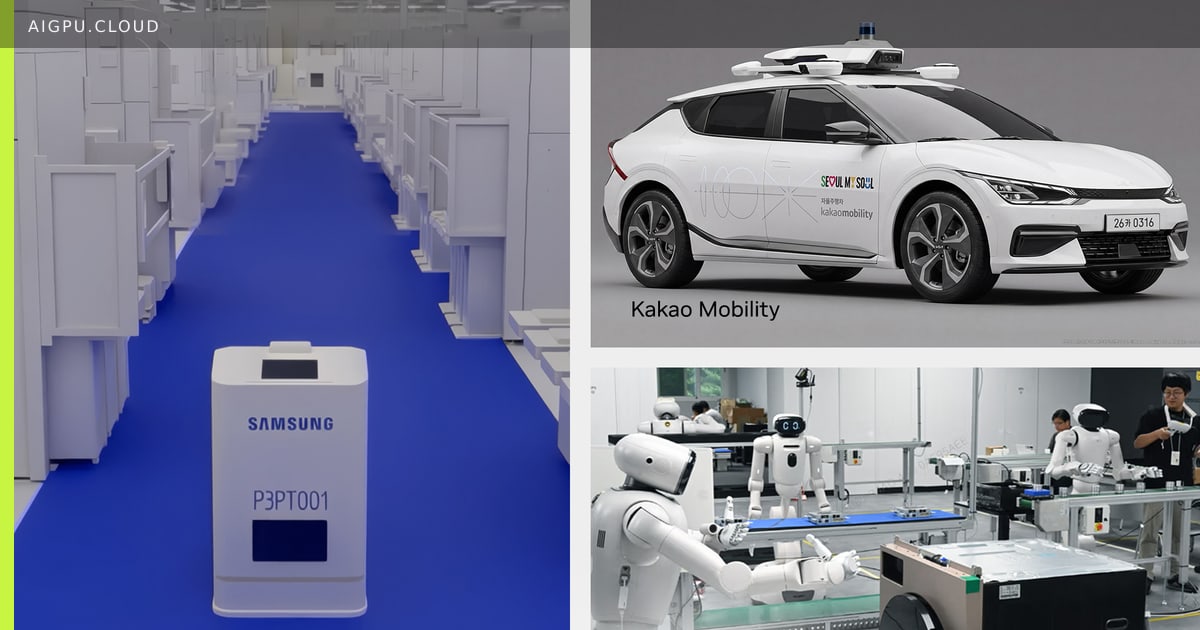
South Korea is leveraging its deep manufacturing base to turn physical AI into a production‑ready capability. NVIDIA’s accelerated computing stack is now embedded in projects that span chip design, self‑driving vehicles and factory robotics.
Key Collaborations
Samsung Electronics is expanding its partnership with NVIDIA to speed up semiconductor R&D. Using cuISS, cuDSS and cuEST, the company has cut quantum‑chemical simulation times by up to 5×, while a PhysicsNeMo‑driven thermal analysis achieved a 1,600× speedup — reducing an 18‑hour CPU run to 41 seconds on GPU.
Kakao Mobility plans to build a Level‑4 autonomous driving system on NVIDIA Hyperion and DRIVE AGX Thor, integrating its Seoul‑tested software with NVIDIA Halos for end‑to‑end safety validation.
LG Electronics demonstrated a physical‑AI data flywheel with its CLOiD robot, combining real‑world data capture, Cosmos‑based augmentation, GR00T model training on Jetson AGX Thor, and simulation‑based evaluation for continuous improvement.
Why it matters for GPU / AI infrastructure: These deployments show how a single accelerated platform can serve diverse physical‑AI workloads — from massive sparse‑matrix solves in chip design to real‑time perception in autonomous fleets and closed‑loop robot learning. For cloud providers like AiGpu, the demand signals a growing need for heterogeneous GPU clusters that can simultaneously handle simulation, training and inference at scale.
- aigpu
- ai gpu
- ai gpu cloud
- aigpu dubai
- physical-ai
- korea
- semiconductor
- autonomous-driving
By AiGpu Editorial · Editorial rewrite based on public reporting (NVIDIA Blog)
← All articles