Industry·
SimReady Central Unveils Open Library of Simulation-Ready 3D Assets for Robotics and AI Factories
Nvidia's SimReady Central launches an open library of over 2,000 simulation-ready OpenUSD assets, enabling developers to build robotics and AI factory digital twins faster by providing pre-configured collision geometry, mass, friction, and sensor metadata that eliminate manual property setup.
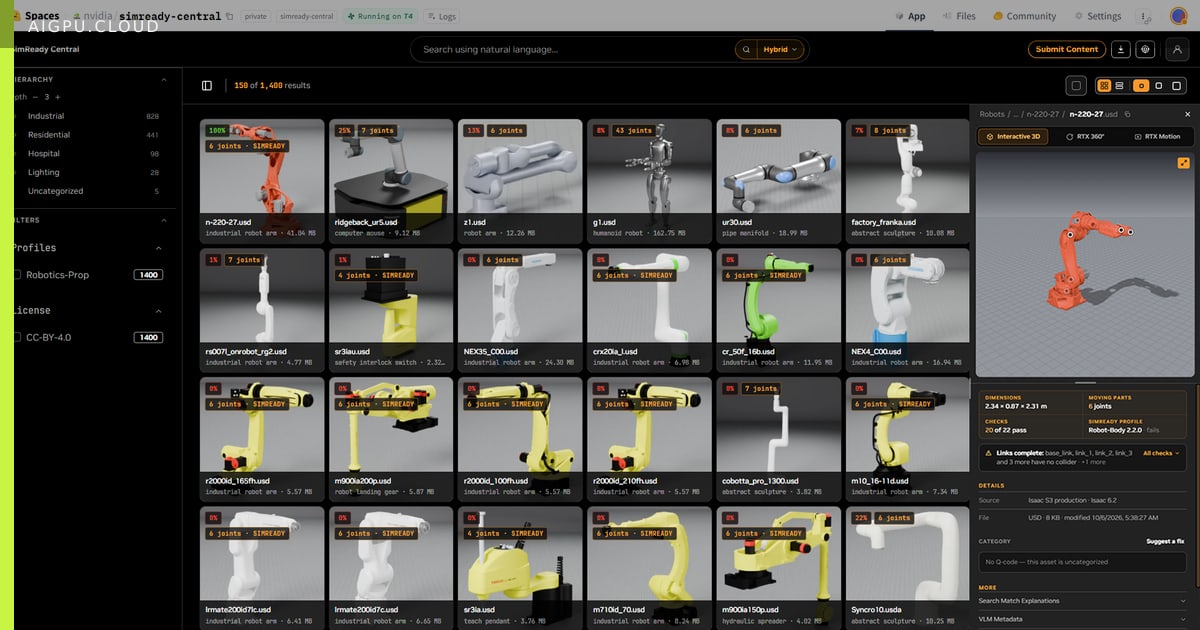
SimReady Central: An Open Library for Simulation-Ready 3D Assets
Nvidia has announced SimReady Central, a free and ungated library of over 2,000 OpenUSD assets designed specifically for robotics and AI factory digital twin development. These assets go beyond basic 3D geometry—they are pre-configured with essential simulation properties such as collision geometry, mass, friction coefficients, joint limits, semantic labels, materials, and sensor attributes. This reduces the manual effort typically required to adapt raw CAD models into production-ready simulation environments.
What Makes an Asset "SimReady"?
A SimReady asset is defined as an OpenUSD model that includes the additional contextual information needed for simulation workflows. While a detailed 3D mesh provides the visual form, simulation requires explicit data about how objects behave physically—whether they collide realistically, move according to joint constraints, respond to sensors, and interact with their environment. The SimReady Foundation provides specifications, profiles, and validation tools that make these requirements explicit across different use cases.
OEM Contributions and Asset Composition
Equipment manufacturers (OEMs) can now prepare and validate their assets against SimReady requirements before publishing them to SimReady Central. Once validated, these assets reach developers who can combine multiple sources—such as robot arms from one supplier and warehouse equipment from another—into cohesive scenes. This interoperability accelerates decision-making and allows industries to build end-to-end simulations around their specific products while maintaining control over their own Hugging Face datasets.
Practical Application: A Robotic Pick-and-Place Scenario
Developers can select assets whose profiles match their workflow needs—for example, a robotic arm with documented collision geometry, gripper friction parameters, and thermal metadata. By assembling these components within the SimReady ecosystem, teams can rapidly prototype and compare AI factory layouts, significantly shortening the time from concept to validated simulation. This approach directly supports the industry shift toward faster, more reliable deployment of autonomous systems.
Why it matters for GPU/AI infrastructure: As AI factories become increasingly complex, having standardized, simulation-ready assets at scale reduces the computational overhead of custom asset creation. This enables organizations to leverage cloud GPU resources more efficiently, accelerating both research and commercial deployment cycles.
- aigpu
- ai gpu
- ai gpu cloud
- aigpu dubai
- simready
- robotics
- ai infrastructure
- cloud computing
By AiGpu Editorial · Editorial rewrite based on public reporting (Hugging Face Blog)
← All articles