Research·
Physics-Informed AI Model Tracks Fetal Brain Motion for Sharper Prenatal MRI
MIT and Boston Children's Hospital researchers unveil E(3)-Pose, a symmetry-aware deep learning model that corrects fetal motion in real time during MRI scans, enabling earlier and more reliable detection of brain developmental anomalies.
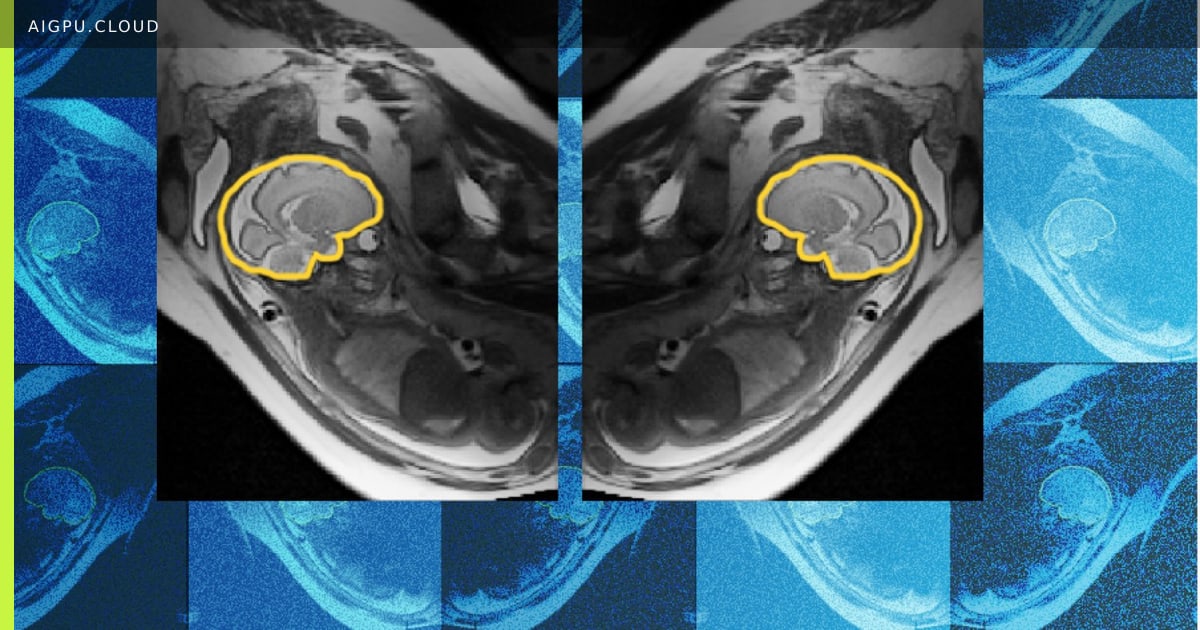
Researchers from MIT, Boston Children's Hospital, and Inria have introduced E(3)-Pose, a deep learning system that aligns fetal brain MRI slices on the fly by embedding left–right symmetry directly into its neural architecture. Instead of learning physics from data alone, the model bakes geometric priors into its layers, allowing it to infer the head's orientation even when the fetus moves between 2D acquisitions.
Why it matters for GPU / AI infrastructure
E(3)-Pose demonstrates how physics-informed inductive biases reduce the data and compute burden for medical imaging tasks. By constraining the hypothesis space with symmetry, the network converges faster and generalizes better from limited annotated scans — a pattern that translates to lower GPU-hours per training run and smaller memory footprints during inference, both critical for clinical deployment on edge or hybrid cloud GPU fleets.
The approach was validated on clinical fetal MRI datasets and presented at the 2026 European Conference on Computer Vision. Radiologists reported fewer coverage gaps and more consistent volumetric reconstructions, potentially sparing families repeat hospital visits and enabling earlier intervention for conditions such as cortical malformations or ventriculomegaly.
As prenatal imaging workflows shift toward real-time AI assistance, models like E(3)-Pose highlight the value of co-designing algorithmic structure with hardware constraints — symmetry priors today, equivariant layers tomorrow — to keep inference latency within the tight windows demanded by moving anatomy.
- aigpu
- ai gpu
- ai gpu cloud
- aigpu dubai
- fetal mri
- prenatal diagnosis
- medical ai
- symmetry learning
By AiGpu Editorial · Editorial rewrite based on public reporting (MIT News AI)
← All articles