Infrastructure·
NVIDIA Warp and MJWarp Revolutionize Robotics Simulation with GPU Acceleration
NVIDIA's Warp and MJWarp platforms are transforming robotics simulation by leveraging GPU acceleration to run thousands of parallel environments. This innovation significantly boosts throughput for AI and machine learning workloads in robotics.
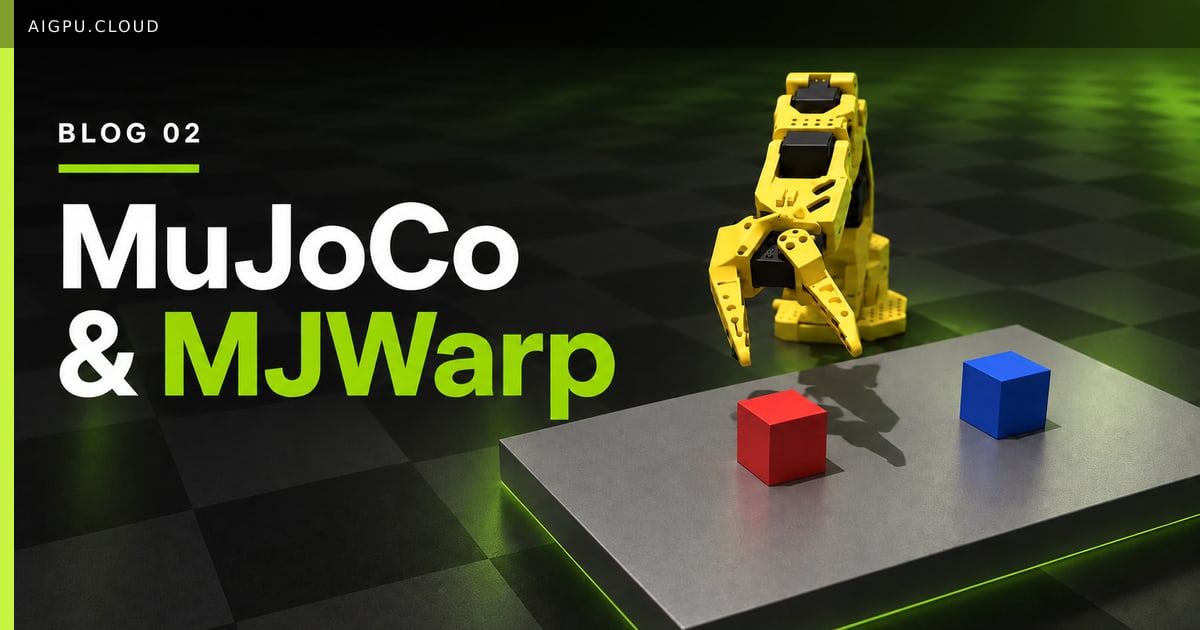
Accelerating Robotics with GPU Power
The field of robotics simulation is undergoing a significant transformation, driven by the increasing demands of AI and machine learning. Traditional CPU-based simulation, while effective for single-world scenarios, struggles to keep pace with the need for massive parallelization required by modern learning algorithms. NVIDIA is addressing this challenge head-on with its Warp and MuJoCo Warp (MJWarp) platforms, designed to harness the power of GPUs for unprecedented simulation throughput.
NVIDIA Warp is a Python-based framework that allows developers to write high-performance, GPU-accelerated kernels. It compiles Python code for CUDA execution, enabling native-CUDA speeds through just-in-time (JIT) compilation and kernel fusion. This framework is particularly valuable for robotics due to its explicit parallel work capabilities, device-specific array management, and composable kernel launches.
Building upon Warp, MJWarp integrates MuJoCo's renowned physics engine into a GPU-accelerated environment. While classic MuJoCo excels at single-robot development and inspection on CPUs, MJWarp's strength lies in its ability to manage and advance hundreds or thousands of independent simulation worlds concurrently on NVIDIA GPUs. This paradigm shift prioritizes aggregate throughput – the total number of world-steps completed per second – over the latency of a single environment, making it ideal for reinforcement learning and large-scale sampling tasks.
Why it matters for GPU / AI infrastructure
For GPU cloud providers and AI hardware buyers, the advent of MJWarp signifies a critical demand driver. Robotics, a burgeoning sector for AI applications, now requires substantial GPU resources not just for training models, but also for simulating complex environments at scale. This translates into a need for high-performance GPUs capable of handling massive parallel computations and efficient memory management. Infrastructure supporting these workflows must offer robust, scalable GPU instances to facilitate rapid iteration and development in robotics and physical AI.
- Performance: Native-CUDA speed via JIT compilation and kernel fusion.
- Ease of Use: Pure Python authoring with built-in primitives.
- Capability: Differentiable kernels and DLPack-style interoperability for seamless integration into ML training loops.
- aigpu
- ai gpu
- ai gpu cloud
- aigpu dubai
- robotics
- simulation
- gpu acceleration
- nvidia warp
- mujoco
- ai infrastructure
By AiGpu Editorial · Editorial rewrite based on public reporting (Hugging Face Blog)
← All articles