Hardware·
NVIDIA Unveils Rubin HPC GPU and Vera CPU Platform at SC26, Ushering in Agent-Driven Scientific Computing
At SC26, NVIDIA's Ian Buck introduced Nemotron for Science, the Rubin HPC GPU, and expanded Vera CPU platform — positioning AI agents as the new interface for simulation, quantum, and high-performance research.
NVIDIA used its SC26 special address in Chicago to outline a hardware and software stack built around autonomous AI agents that can plan experiments, execute code, and validate results on researchers' own infrastructure. Vice President of Hyperscale and HPC Ian Buck framed the shift as the convergence of simulation, AI, and quantum computing — a stack where agents become the primary operators.
New Hardware Foundations
The centerpiece is the Rubin HPC GPU, a science-focused accelerator expected in 2028 with over 50,000 CUDA cores — roughly three times the count of Hopper — supporting precisions from FP64 down to FP4, sparse-data acceleration, and seventh-generation NVLink interconnects. Complementing it, the Vera CPU platform adds high-throughput cores optimized for the tool-calling loops that agents rely on between model steps. The German Climate Computing Center (DKRZ) has already selected Vera for its HLRE-5 supercomputer slated for early 2028, joining previously announced deployments at the Texas Advanced Computing Center.
On the software side, Nemotron for Science packages the Nemotron 3.5 Super VL open model with a curated chemistry dataset and post-training recipes for life sciences. Researchers can run it locally on a DGX Spark, workstation, or sovereign supercomputer, retaining full ownership of data and model weights. Early demonstrations include an agent at Argonne National Laboratory that discovered two new binding sites from a single prompt, a GROMACS repair agent from KTH that fixed 81% of broken setups overnight on one DGX Spark, and NVIDIA's own Nsight AI Porting Agent accelerating a WRF weather model routine over 5x using roughly 150 million tokens.
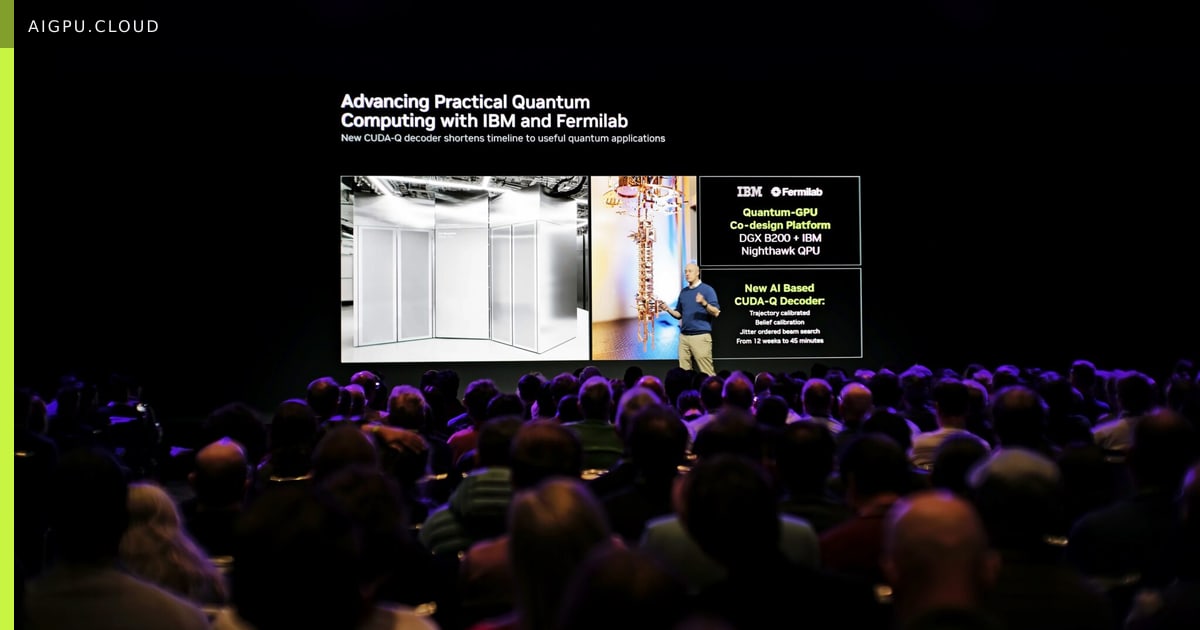
A quantum collaboration with IBM and Fermi National Accelerator Laboratory rounds out the announcement, targeting hybrid quantum-classical workflows on the same infrastructure.
Why it matters for GPU / AI infrastructure: The agent loop — model inference, tool execution, result evaluation — places new demands on CPU-GPU balance, memory bandwidth, and low-latency interconnects. Rubin and Vera are architected explicitly for that loop, signaling that the next procurement cycle for HPC centers will prioritize agent-native throughput over raw peak FLOPS alone.
- aigpu
- ai gpu
- ai gpu cloud
- aigpu dubai
- nvidia
- hpc
- rubingpu
- veracpu
By AiGpu Editorial · Editorial rewrite based on public reporting (NVIDIA Blog)
← All articles