Industry·
NVIDIA Expands Open Model Portfolio to Accelerate Europe's Sovereign AI Development
New Nemotron, Kumo, and domain-specific model families give European enterprises flexible foundations for building localized AI agents on controlled infrastructure.
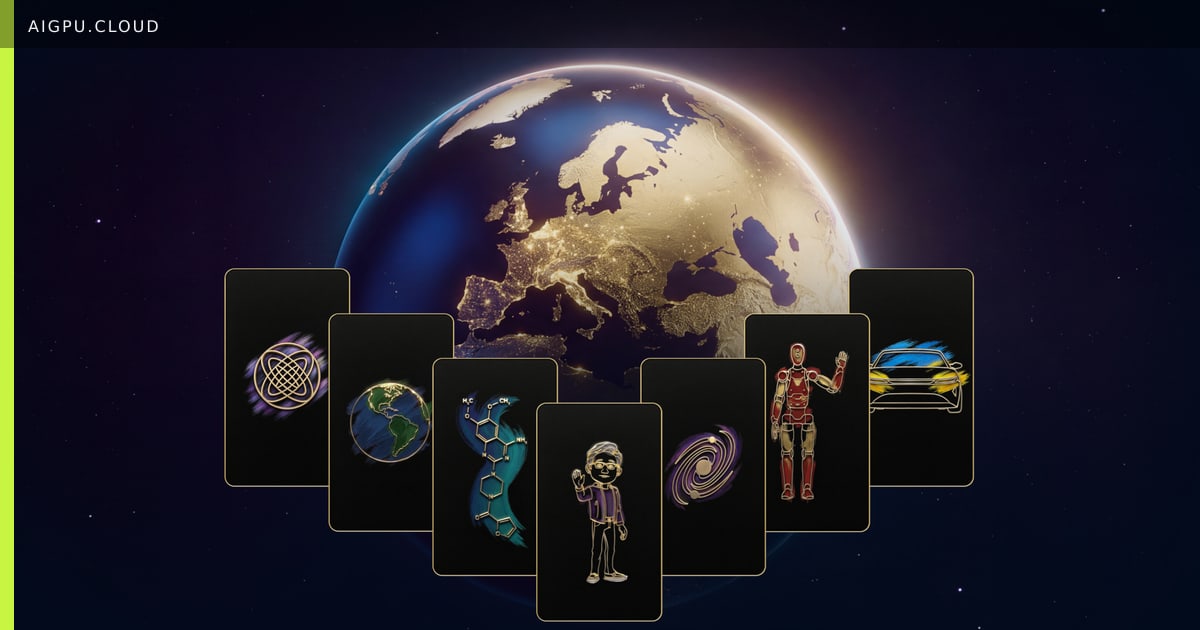
NVIDIA has unveiled a significantly expanded suite of open-weight model families designed to give European developers and enterprises the building blocks for sovereign AI applications. The release spans language and vision (Nemotron 3.5 Super VL and Bolt), retrieval and document understanding (Nemotron Retriever), structured business data (Kumo), physical world simulation (Cosmos 3.5), autonomous vehicles (Alpamayo 2 Edge), life sciences (BioNeMo), and quantum computing (Ising). Critically, these models are engineered for post-training customization with proprietary data and deployment on infrastructure the organization controls — a direct response to Europe's data sovereignty and regulatory requirements.
The Nemotron coalition now includes European research partners Black Forest Labs, H-Company, and Mistral, ensuring the models reflect regional linguistic and cultural nuances. Early adopters such as Dassault Systèmes, SAP, and Salesforce are already building domain-specific agents on this foundation, while a broad post-training ecosystem — including CoreWeave, Nebius, and Scale AI — helps enterprises adapt the models for specialized workloads without starting from scratch.
Kumo Brings Foundation Model Approach to Tabular Data
A standout addition is the Kumo family, which applies foundation model principles to structured enterprise data. Instead of building separate ML pipelines for each prediction task — fraud scoring, demand forecasting, churn prediction — teams can use pretrained Kumo models to generate predictions rapidly, then fine-tune with proprietary data when higher accuracy is needed. Cognite, Coinbase, Databricks, and Revolut are among the first to integrate Kumo into production workflows, reporting significant reductions in time-to-prediction.
Why it matters for GPU / AI infrastructure: Open-weight models shift the compute burden from massive pre-training runs (which few can afford) to targeted fine-tuning and inference. This aligns perfectly with the economics of GPU cloud: organizations can rent accelerated compute for customization cycles, then deploy optimized models on smaller inference clusters. For AiGpu customers, the expanded model zoo means more ready-to-customize starting points across verticals, reducing time-to-value on sovereign AI projects.
- aigpu
- ai gpu
- ai gpu cloud
- aigpu dubai
- sovereign ai
- open models
- europe
- gpu cloud
By AiGpu Editorial · Editorial rewrite based on public reporting (NVIDIA Blog)
← All articles