Models·
NVIDIA Opens Nemotron 3.5 Parse Datasets and Fine-Tuning Recipe for Document AI
NVIDIA releases three massive synthetic datasets and a two-stage training methodology behind Nemotron 3.5 Parse, enabling faster, more accurate document understanding for RAG and agent workflows.
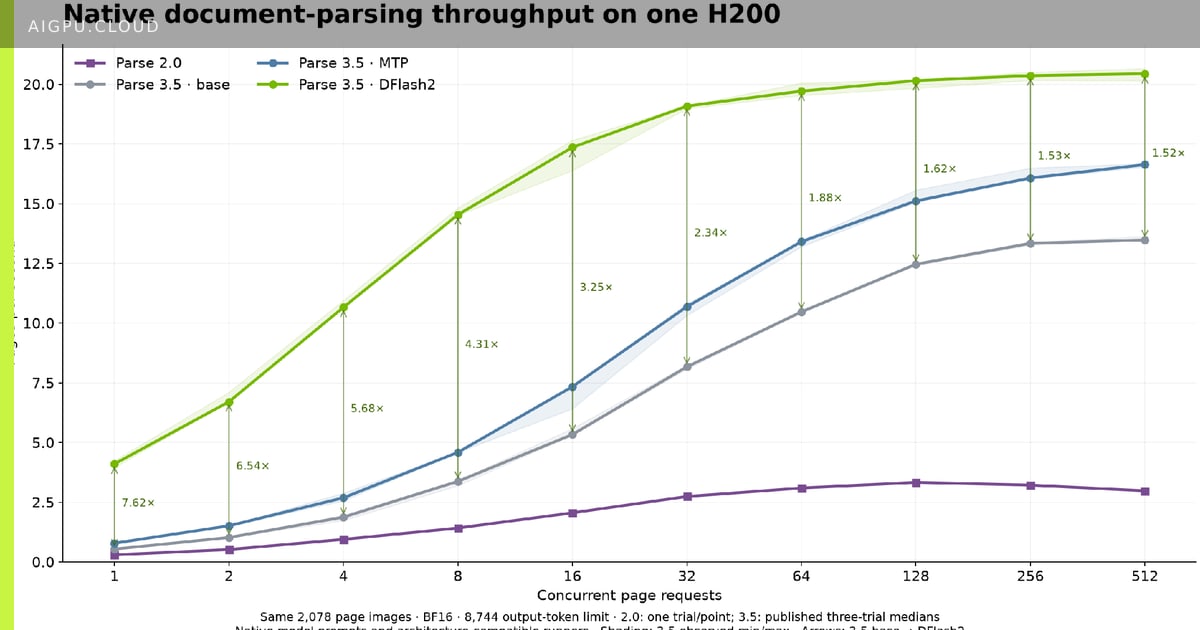
NVIDIA has expanded its Nemotron 3.5 Parse release with open datasets, a fine-tuning playbook, and a speculative decoding module that accelerates inference. The compact vision-language model converts page images into structured, reading-order data — headings, paragraphs, tables, and charts with bounding boxes — purpose-built for retrieval-augmented generation and autonomous agents.
Three open synthetic corpora
The company is publishing the exact training pairs used to teach Parse 3.5: Synthetic Charts V1 (9.98 million rendered charts with ground-truth series and values), Synthetic Tables V1 (1 million HTML tables preserving row, column, and header relationships), and OCR Synthetic Multilingual v2 (7.9 million pages across fonts and layouts). Each bundle includes images, annotations, generation scripts, and the training format so teams can adapt the model to proprietary document types or low-resource languages.
Two-phase training: SFT then verifiable RL
Parse 3.5 learned document understanding through supervised fine-tuning across text, layout, tables, charts, and multilingual pages. A subsequent reinforcement-learning stage — Group Relative Policy Optimization with verifiable rewards — sharpened consistency: extractions earn higher scores when they recover correct chart series, produce usable table structures, and terminate cleanly without repetition.
For inference speed, NVIDIA bundles a DFlash2 speculator that drafts tokens for the main model to verify, cutting latency on GPU deployments. The full recipe — data, checkpoints, training configs, and the speculator — is available on Hugging Face and GitHub.
Why it matters for GPU / AI infrastructure: Document-heavy enterprises can now fine-tune a production-grade parser on their own GPU clusters without curating millions of labeled pages. The synthetic corpora remove the labeling bottleneck, while the RLVR recipe and speculator deliver higher throughput per GPU — directly lowering cost per document processed.
- aigpu
- ai gpu
- ai gpu cloud
- aigpu dubai
- nvidia
- document-ai
- synthetic-data
- fine-tuning
By AiGpu Editorial · Editorial rewrite based on public reporting (Hugging Face Blog)
← All articles