Infrastructure·
Microduck Obstacle Avoidance: Sim2Real Workflow with Isaac Lab and Newton
NVIDIA's Isaac Lab and Newton physics engine enable a modular Sim2Real pipeline that adds local obstacle avoidance to the Microduck quadruped without altering its walking policy. The tutorial covers environment setup, sensor modeling, policy training across thousands of parallel GPU simulations, and deployment on real hardware.
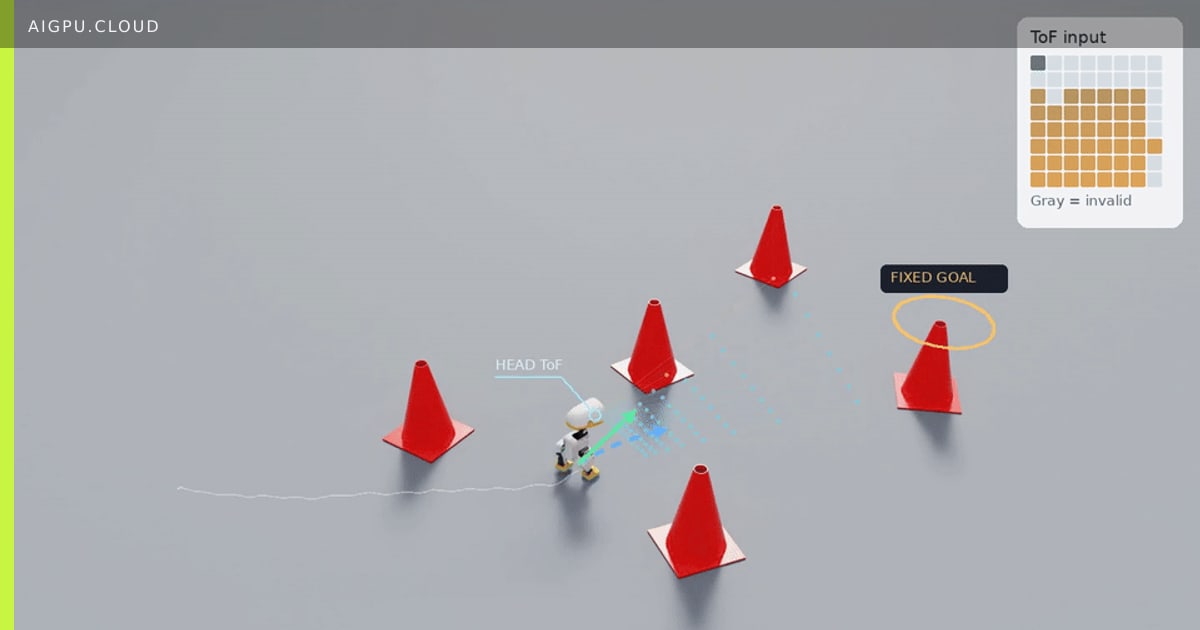
Engineers can now extend the Microduck quadruped with a lightweight avoidance controller that sits on top of a fixed walking policy. By keeping the locomotion weights unchanged, the team isolates the new behavior and reduces the risk of destabilizing the robot's balance.
The workflow builds diverse obstacle courses from reusable SimReady USD assets, models a time‑of‑flight depth sensor with Newton's raycaster, and trains the avoidance network in Isaac Lab using massive GPU‑parallel rollouts. This approach yields a policy that adjusts gamepad velocity commands in real time to steer around boxes, bins, and cabinets.
After training, the policy is exported and evaluated in simulation across randomized layouts before being transferred to a physical Microduck equipped with a matching ToF sensor and gamepad. The same exported walking checkpoint is reused, ensuring a seamless hand‑off from virtual to real worlds.
Why it matters for GPU and AI infrastructure
Running thousands of simultaneous physics environments demands high‑throughput GPU compute and low‑latency interconnects — exactly the workloads that modern AI‑focused cloud platforms are built to serve. By demonstrating a complete Sim2Real loop on open‑source tooling, the tutorial highlights how scalable GPU clusters accelerate robotics research and reduce time‑to‑deployment for embodied AI.
- aigpu
- ai gpu
- ai gpu cloud
- aigpu dubai
- sim2real
- isaac-lab
- robotics
- nvidia
By AiGpu Editorial · Editorial rewrite based on public reporting (Hugging Face Blog)
← All articles