Infrastructure·
Hill-Climbing Inkling 2 Mini Inference on a Single RTX PRO 6000
Hugging Face engineers used an automated coding agent to push Inkling 2 Mini throughput 40% higher on NVIDIA's 96 GB RTX PRO 6000, beating community benchmarks and validating the GPU for production MoE serving.
Inkling 2 Mini arrived last week as a 26-billion-parameter mixture-of-experts model with only 3 billion active parameters per token, a 1-million-token context window, and multimodal input support. Its unusual looped MoE architecture — 24 physical layers where the middle 12 execute three times per token — delivers 48 effective layers while keeping memory pressure modest. The checkpoint ships in mixed NVFP4 and MXFP8 precision and includes a DSpark drafter for speculative decoding, making it an attractive target for local and cloud inference on mid-range accelerators.
Official serving recipes from vLLM and SGLang currently target NVIDIA B200 and GB300 (sm100), leaving the RTX PRO 6000 (sm120) without validated kernels. To close that gap, Hugging Face gave a coding agent an inference-optimization skill, the HF CLI, and access to HF Jobs running on the same RTX PRO 6000 96 GB that powers the nvidia-rtx-pro-6000 Inference Endpoint flavor ($2.75/hr). Over 46 controlled benchmark runs, the agent systematically varied one parameter at a time, bracketing each candidate between control runs and accepting only changes that improved throughput without regressing latency or correctness.
Results and Why It Matters for GPU Infrastructure
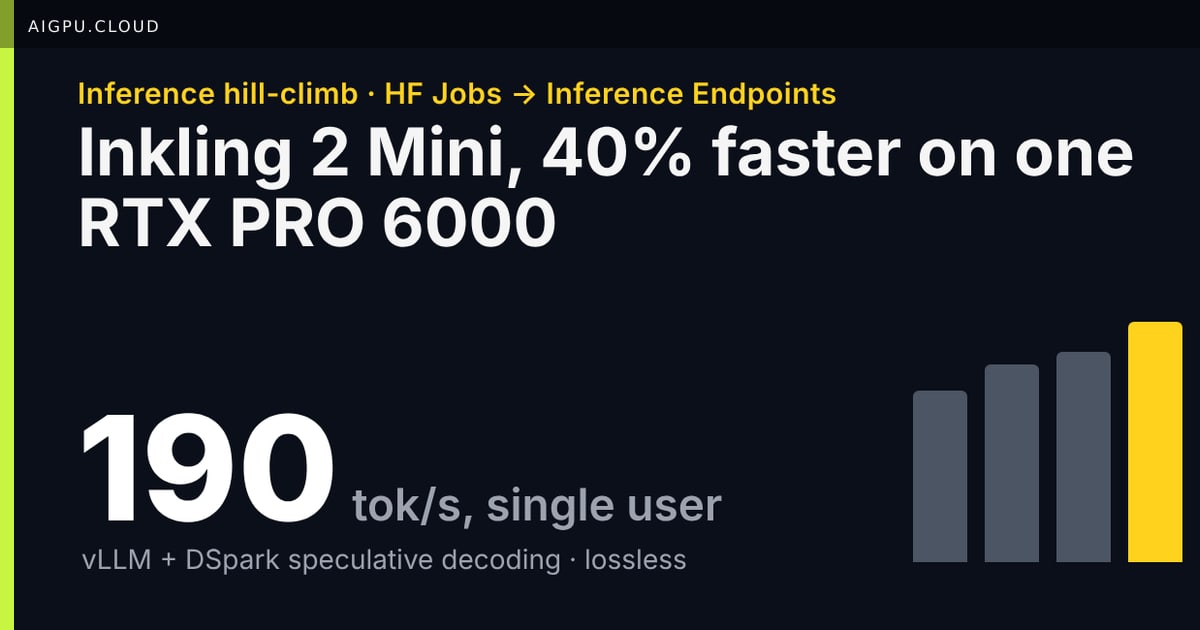
Single-user decode throughput climbed from 136 to 190.6 tokens/second (+40%), surpassing the 167.7 tok/s community benchmark on the same GPU. Eight-user aggregate throughput rose from roughly 570 to 716 tok/s (+26%) using vLLM nightly with DSpark speculative decoding. Greedy outputs remained byte-identical with and without speculation, and long-context needle retrieval passed 3/3 tests up to 250 K tokens. The winning configuration is now deployed as a pinned Inference Endpoint image, with all logs, scripts, and raw measurements published in the NielsRogge/inkling-2-mini-hillclimb repository.
For AI infrastructure teams, this work demonstrates that automated, protocol-driven tuning can unlock significant performance on workstation-class GPUs that lack vendor-optimized recipes. The RTX PRO 6000's 96 GB VRAM and sm120 architecture prove capable of serving state-of-the-art MoE models at competitive throughput, expanding the hardware options for cost-sensitive inference deployments without requiring flagship data-center GPUs.
- aigpu
- ai gpu
- ai gpu cloud
- aigpu dubai
- inference optimization
- rtx pro 6000
- moe models
- vllm
By AiGpu Editorial · Editorial rewrite based on public reporting (Hugging Face Blog)
← All articles