Industry·
IBM's Palette Shows Small Models Can Master Enterprise Slide Design
IBM Research fine-tunes a 20B open-weight model to generate on-brand slide decks using synthetic data and a designer-coder architecture, outperforming frontier models on design consistency benchmarks.
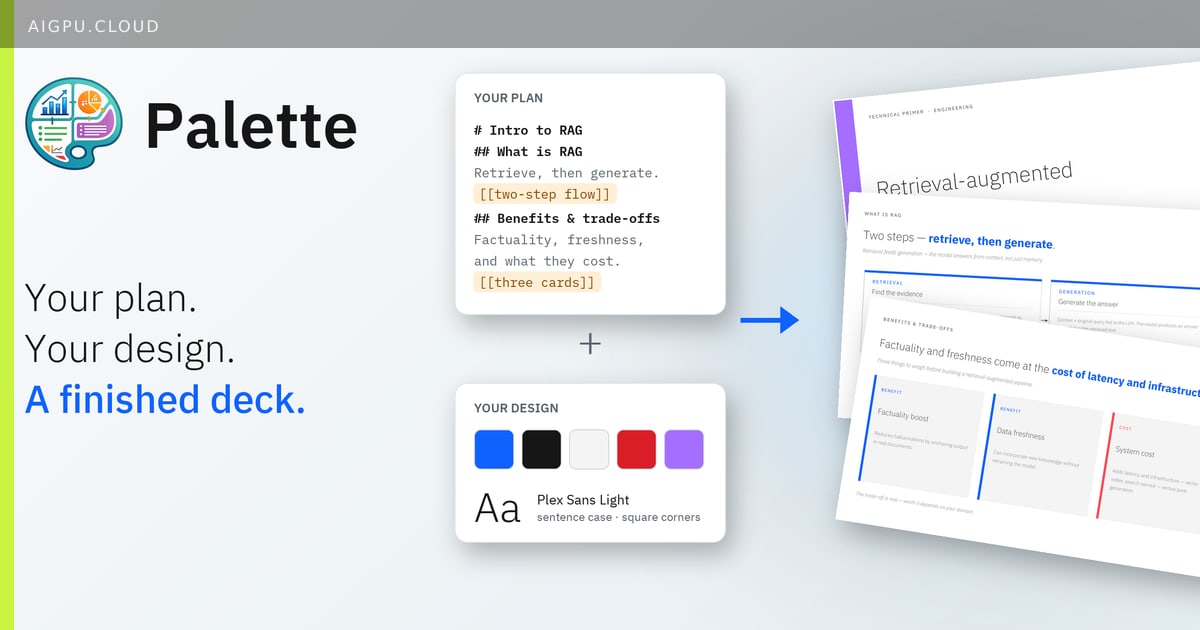
IBM Research has released Palette, a 20-billion-parameter open-weight model fine-tuned to produce slide decks that follow a specific corporate design language. Unlike general-purpose frontier models that drift toward their own house style, Palette stays faithful to brand guidelines while running entirely on private infrastructure.
Designer-coder split mirrors human workflow
The system divides the task into two roles served by a single LoRA adapter. A designer module reads the content plan and emits a structured JSON brief covering palette, typography, and per-slide layout with design rationale. A coder module then translates each slide specification into precise pptxgenjs rendering code. This separation lets the model handle editorial judgment and geometric placement independently, reducing the overlapping text and off-canvas elements that plague smaller models.
Training relied on synthetic data generated to reflect the IBM Design Language, validated by an automated harness that renders and checks every slide. On the PresentBench benchmark, Palette ranks first in two of three measured domains, demonstrating that targeted fine-tuning can close the gap with much larger proprietary systems.
Why it matters for GPU / AI infrastructure: Enterprises that need brand-compliant output without sending confidential content to external APIs can self-host a model of this size on modest GPU clusters. The synthetic-data pipeline also creates a repeatable training workload for teams building custom design-language adapters.
- aigpu
- ai gpu
- ai gpu cloud
- aigpu dubai
- small models
- fine-tuning
- enterprise ai
- synthetic data
By AiGpu Editorial · Editorial rewrite based on public reporting (Hugging Face Blog)
← All articles