Industry·
IBM Research Shows How Multilingual Embeddings Unlock Voice Agents for Indian Farmers
IBM Research demonstrates a voice agent that lets farmers query an English handbook in Hindi, Tamil, or Telugu — revealing why multilingual embeddings are the critical infrastructure layer for cross-lingual AI.
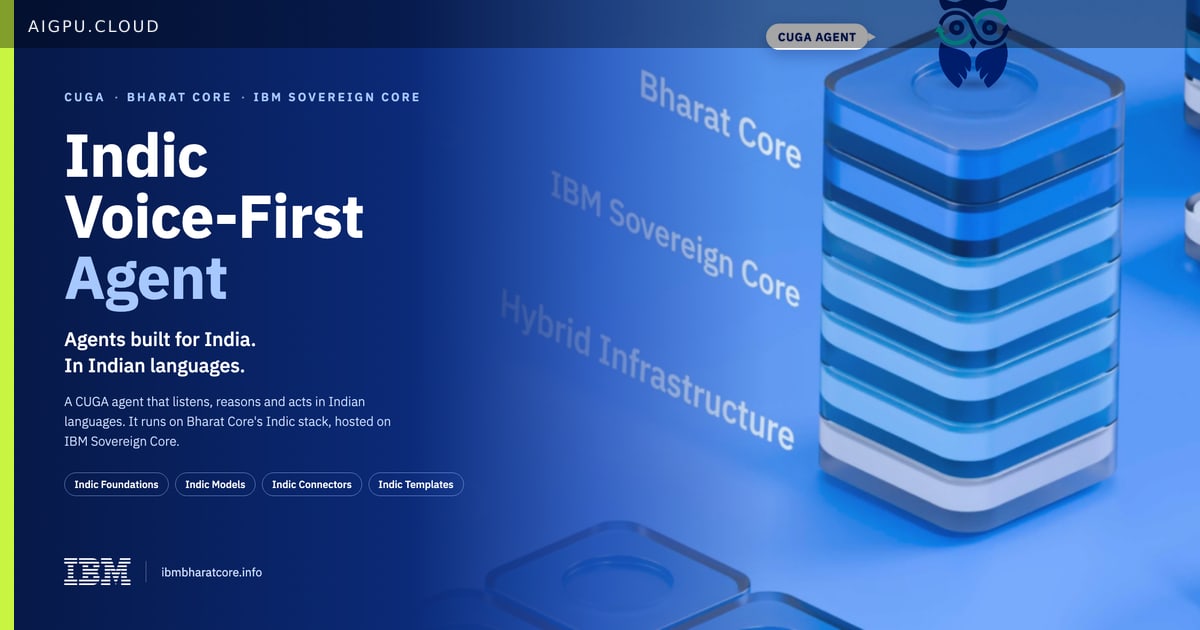
IBM Research has open-sourced a reference implementation of an Indic voice agent that bridges a persistent gap: most agricultural knowledge lives in English, but the farmers who need it speak and think in regional languages. The agent, built on IBM's CUGA (ConfigUrable Generalist Agent) harness, listens to a spoken question, searches a 154-page English handbook, and replies in the same language — citing source pages so answers stay verifiable.
The architecture is deliberately minimal. CUGA provides the text-in, text-out reasoning loop: model wiring, tool management, conversation threads, and guardrails that keep the agent on-topic. Voice is added as two thin layers — speech-to-text on the way in, text-to-speech on the way out — using either Sarvam AI's cloud APIs or self-hosted open models (SraVaani for STT, Svara for TTS). Because the core agent never sees audio, developers can build and test entirely in text before attaching voice.
The infrastructure lesson: embeddings are the bottleneck
The team's key finding is instructive for anyone deploying multilingual RAG. CUGA's default English-only embedding model turned Hindi and Tamil queries into vectors that carried almost no semantic signal. Retrieval returned five passages — but the wrong ones. The model, correctly grounded, then replied that the handbook didn't cover the topic. Every layer behaved correctly; no error surfaced. The fix was swapping in intfloat/multilingual-e5-large, a multilingual embedding model that maps equivalent meanings across languages into the same vector neighborhood.
This is a classic infrastructure problem disguised as a model problem. The embedding model runs on GPU, scales with corpus size, and determines whether retrieval works at all. For teams building voice agents across India's 22 scheduled languages — or any multilingual deployment — the embedding choice is a capacity planning decision, not just a model selection.
Why it matters for GPU infrastructure: multilingual embeddings increase vector dimensionality and compute per query. At scale, that means more GPU memory, higher throughput requirements, and a stronger case for inference-optimized hardware. AiGpu's H100 and A100 clusters are sized for exactly these workloads — where embedding throughput, not just LLM decode, drives the cost curve.
- aigpu
- ai gpu
- ai gpu cloud
- aigpu dubai
- multilingual-embeddings
- voice-agents
- rag
- ibm-research
By AiGpu Editorial · Editorial rewrite based on public reporting (Hugging Face Blog)
← All articles