Models·
IBM Granite Time-Series Ensemble: Four Models, One Forecasting Interface
IBM Research releases Granite Timeseries Ensemble, a permissively licensed recipe that combines four pre-trained Granite architectures into a single forecasting interface — no retraining, no fitted weights, just median and quantile predictions out of the box.
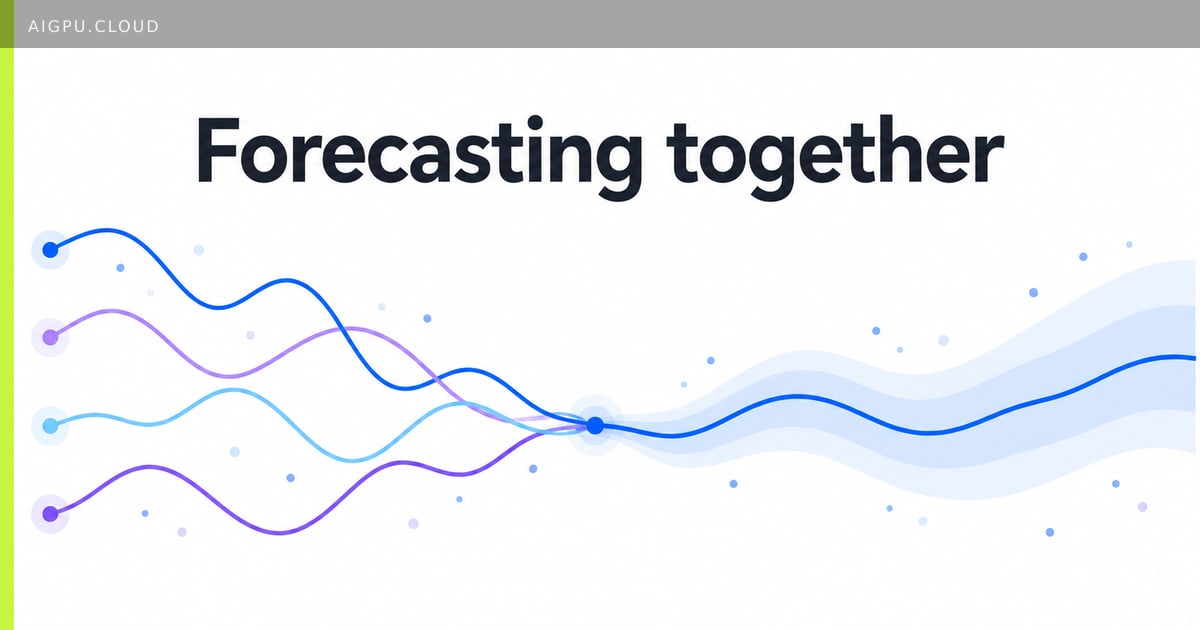
IBM Research has open-sourced Granite Timeseries Ensemble (model ID ibm-granite/granite-timeseries-ensemble-r1), a drop-in forecasting recipe that unifies four complementary Granite time-series models under one API. Instead of guessing which architecture suits a given signal — smooth industrial sensor data, noisy retail demand, or long seasonal horizons — the ensemble runs all four members and returns a probabilistic forecast via uniform probability pooling, with an adaptive IQR variant available for comparison.
Four architectures, zero retraining
The default recipe bundles Granite PatchTST-FM-r1 (patched Transformer), Granite PatchTST-FM-r2 (patched Conformer), Granite FlowState-r1.1 (state-space model), and Granite TTM-r3 (Tiny Time Mixers, an MLP-mixer). Each checkpoint is downloaded at runtime; the ensemble configuration — not merged weights — is what ships on the Hub. Point forecasts and quantile outputs (0.1–0.9 by default) are returned together, giving practitioners a central prediction plus calibrated intervals for risk-aware decisions.
Installation is a single pip install "granite-tsfm>=0.3.11" followed by a few lines of Python. The QuantileEnsembleForecaster.from_pretrained call handles member loading, context windowing, and prediction-length slicing automatically. First-run latency is higher while checkpoints are fetched; subsequent calls are fast because models stay cached locally.
Why it matters for GPU / AI infrastructure: Ensemble inference multiplies compute demand — four forward passes per forecast horizon. For production workloads that serve thousands of series per minute, this translates directly into GPU throughput requirements. Cloud GPU platforms that offer on-demand, per-second billing and rapid cold-start container spin-up (like aigpu.cloud) let teams scale ensemble forecasting horizontally without over-provisioning. Quantile outputs also enable downstream optimization models that run on the same GPU fleet, creating a tight loop between forecasting and decision-making.
The model card on Hugging Face documents member checkpoints, evaluation benchmarks, and known limitations. Because the recipe is permissively licensed, enterprises can embed it in commercial products or adapt the ensemble interface to swap in proprietary forecasters alongside the Granite members.
- aigpu
- ai gpu
- ai gpu cloud
- aigpu dubai
- time-series
- forecasting
- ibm-granite
- ensemble-learning
- hugging-face
By AiGpu Editorial · Editorial rewrite based on public reporting (Hugging Face Blog)
← All articles