Research·
Hugging Face Demonstrates Harness Adapters: RL-Trained LoRAs Boost Agent Efficiency on Qwen3-27B
New research shows freezing base model weights and adding harness-specific LoRA adapters trained via RL inside agent environments yields 55% pass@1 on Terminal-Bench (up from 39%) while cutting token usage nearly in half.
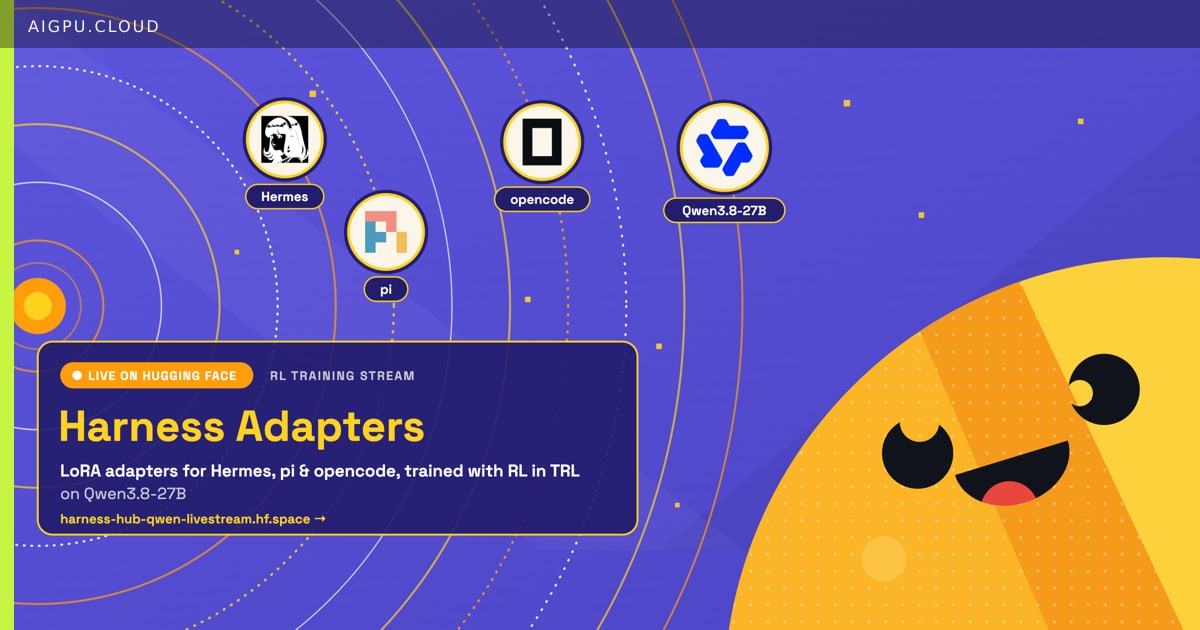
Hugging Face has published a reproducible recipe for training harness adapters — lightweight LoRA modules optimized via reinforcement learning inside specific agent harnesses. The team froze Qwen3-8B-27B weights and trained one adapter per harness (Pi, OpenCode, Hermes Agent) using TRL's AsyncGRPOTrainer running on Hugging Face Jobs with OpenEnv and Harbor docker images.
Results are striking: on Terminal-Bench 2.1 under the Pi harness, the adapted model reaches 55% pass@1 versus 39% for the base model, while average token consumption drops from 2.9K to 1.5K per task. The adapters achieve gains by reducing unnecessary reasoning steps, fewer tool calls, and higher first-attempt success rates.
A merged super-adapter combining all three LoRAs runs unchanged across Pi, OpenCode, and Hermes Agent, simplifying deployment. All artifacts — adapters, GGUF quantizations, RL task datasets, and a safeagents plugin — are available in a public Hugging Face collection.
Why it matters for GPU / AI infrastructure
Harness adapters demonstrate a compute-efficient path to specializing large models: no full fine-tuning, no massive GPU clusters. RL training occurs inside the target harness using async GRPO, which maximizes GPU utilization by overlapping rollout generation with gradient updates. For teams running agent workloads on rented GPU clouds, this pattern slashes both training cost and inference token spend — directly improving $/task economics.
- aigpu
- ai gpu
- ai gpu cloud
- aigpu dubai
- lora
- reinforcement-learning
- agent-harness
- qwen
By AiGpu Editorial · Editorial rewrite based on public reporting (Hugging Face Blog)
← All articles