Industry·
European Retail Accelerates with Open Models and Physical AI on NVIDIA Infrastructure
From Shopify's 90% inference cost cut to Zooplus's 86% search accuracy, European retailers are deploying open models and digital twins on NVIDIA GPUs to transform commerce and fulfillment.
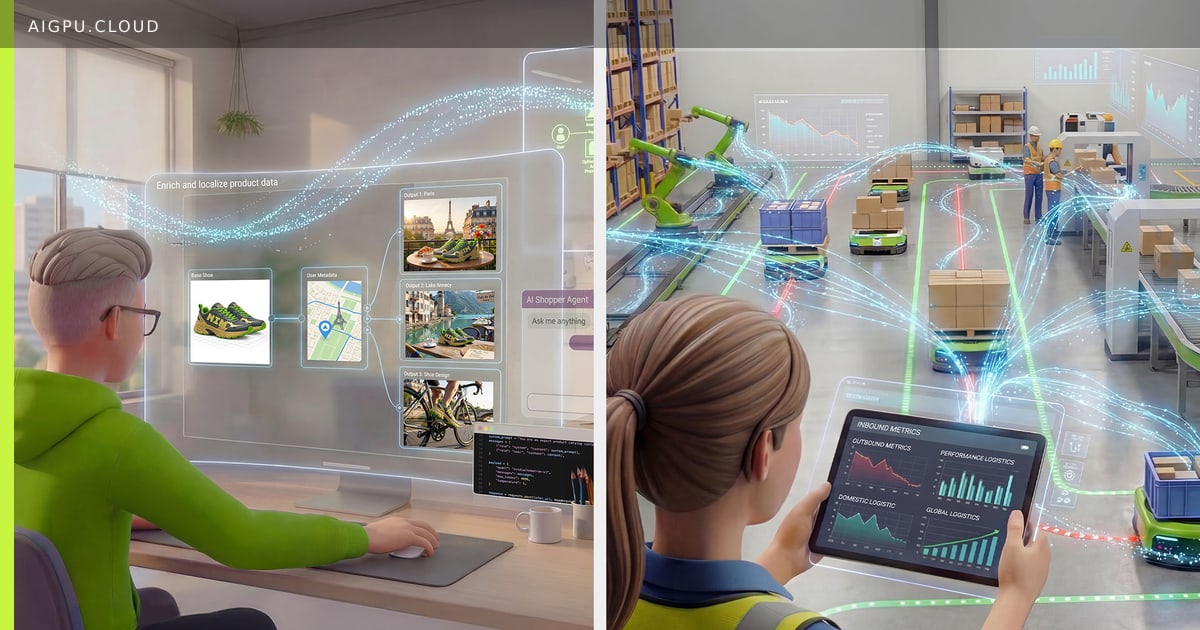
European retailers are moving beyond pilot projects into production-scale AI, leveraging open models and physical intelligence across the commerce stack. Shopify post-trained NVIDIA Nemotron 3.5 Lightning using Megatron Bridge and NeMo RL, achieving frontier-level accuracy for its GraphQL subagent while slashing serving costs by 90% and delivering responses seven times faster. The same CCluster vLLM optimization yielded 4.5x throughput gains and up to 12x lower inference cost across catalog enrichment, merchant assistance, and recommendation workloads.
Zooplus, Europe's leading pet retailer, rebuilt its product discovery pipeline with Infosys on AWS using Nemotron Retriever for semantic search and the NVIDIA retail catalog enrichment blueprint. The production prototype reached 86% search accuracy with generated, search-ready attributes. Meanwhile, Photoroom's Image Editing API — running on TensorRT and Triton Inference Server — standardizes 40,000 primary images daily across 70 countries for Vestiaire Collective, driving a 5% lift in listing liquidity and 3–7% more unique page views.
Digital Twins and Molecular Screening Extend Physical AI
Omi's ProductDrop workflow anchors generated creative assets to approved digital twins, enabling brands like L'Oréal to scale catalog imagery without product errors. TRELLIS 3D generation on RTX PRO 6000 Blackwell Server Edition GPUs delivers 10x faster inference and 4x lower pipeline latency. In R&D, L'Oréal integrates NVIDIA ALCHEMI to compress ingredient combination screening from months to hours, and is testing CurieOS with OrbMol-v2 for open molecular simulation.
Why it matters for GPU / AI infrastructure: These deployments show that open-model fine-tuning, optimized inference runtimes, and digital-twin workloads are converging on the same accelerated infrastructure. Retailers need GPU clusters that handle both high-throughput serving (vLLM, Triton) and compute-intensive 3D generation or scientific simulation — a dual-profile demand that favors flexible, high-memory platforms like Blackwell.
- aigpu
- ai gpu
- ai gpu cloud
- aigpu dubai
- retail ai
- open models
- digital twin
- inference optimization
By AiGpu Editorial · Editorial rewrite based on public reporting (NVIDIA Blog)
← All articles