Hardware·
Building a $50 AI Companion: How One Developer Hacked Meta's Muse Charm with Open Hardware
A developer transforms a $50 ESP32-S3 devkit into a fully featured AI wearable using Meta's Muse cloud and Claude Code, showcasing the democratization of AI hardware.
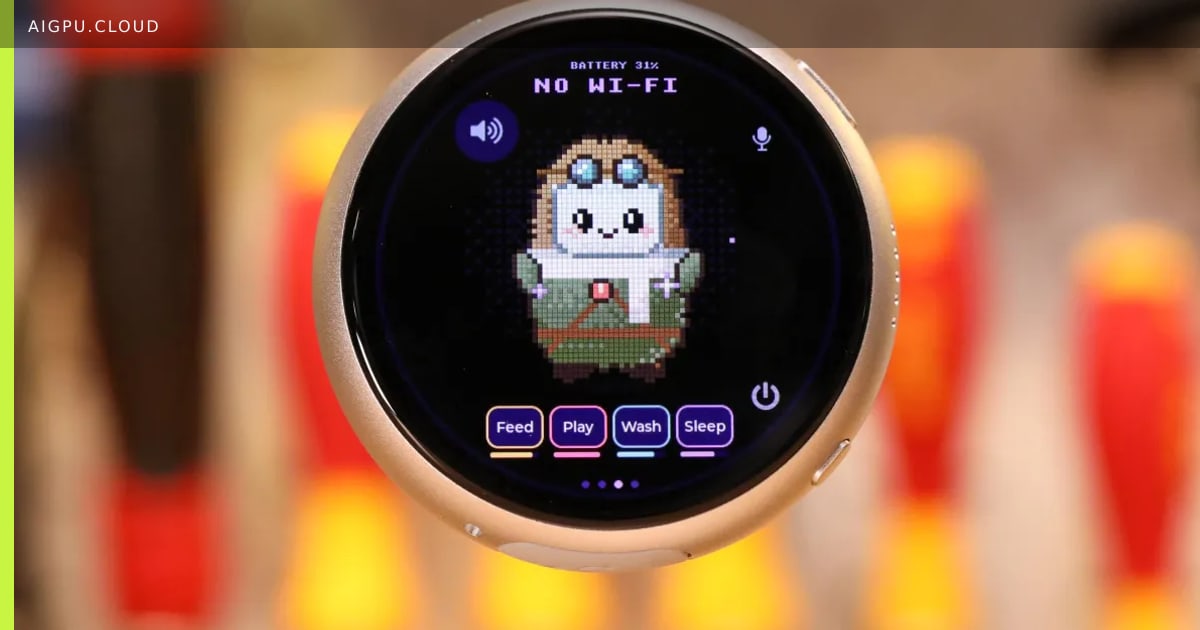
Sean Hollister, senior editor at The Verge, recently built his own AI companion pendant using a Waveshare ESP32-S3 1.75C development kit — a $50 touchscreen device officially supported by Meta for its Muse Gadgets program. The kit connects directly to Meta's Muse AI cloud via open-source tokens, offering a low-cost entry point for experimenting with wearable AI.
From Basic Kit to Polished Prototype
Out of the box, the device could push-to-talk with Muse but suffered from slow responses, no on-device audio playback, truncated on-screen text, and a single static avatar. It also lacked automatic smart-home discovery and a remote camera shutter. Hollister plugged the pendant into his PC and used Anthropic's Claude Code to iteratively rewrite the firmware, adding a swipeable conversation history, ElevenLabs British voice output, a functional camera remote trigger, and smarter smart-home integration.
The result is a pocket-watch-sized gadget that talks back, shows full message threads, snaps photos remotely, and controls connected devices — all for a fraction of the cost of Meta's upcoming consumer Muse Charm. The project highlights how accessible AI hardware development has become when cloud inference, open APIs, and generative coding tools converge.
Why it matters for GPU / AI infrastructure: This experiment illustrates the growing demand for low-latency cloud inference at the edge. Each voice interaction, avatar animation, and smart-home command routes through Meta's GPU clusters. As millions of such devices come online, the need for scalable, geographically distributed AI compute — like what AiGpu provides — becomes critical to keep response times snappy and costs manageable.
- aigpu
- ai gpu
- ai gpu cloud
- aigpu dubai
- edge ai
- esp32
- meta muse
- ai hardware
By AiGpu Editorial · Editorial rewrite based on public reporting (The Verge AI)
← All articles