Research·
AI Agents Invent Their Own Games in Unsupervised Simulation
MIT researchers let 13 autonomous agents roam a virtual island with no tasks. The agents spontaneously created challenges, discovered physics tricks, and later outperformed non‑explorers on goal‑directed tests — suggesting unstructured play builds richer world models.
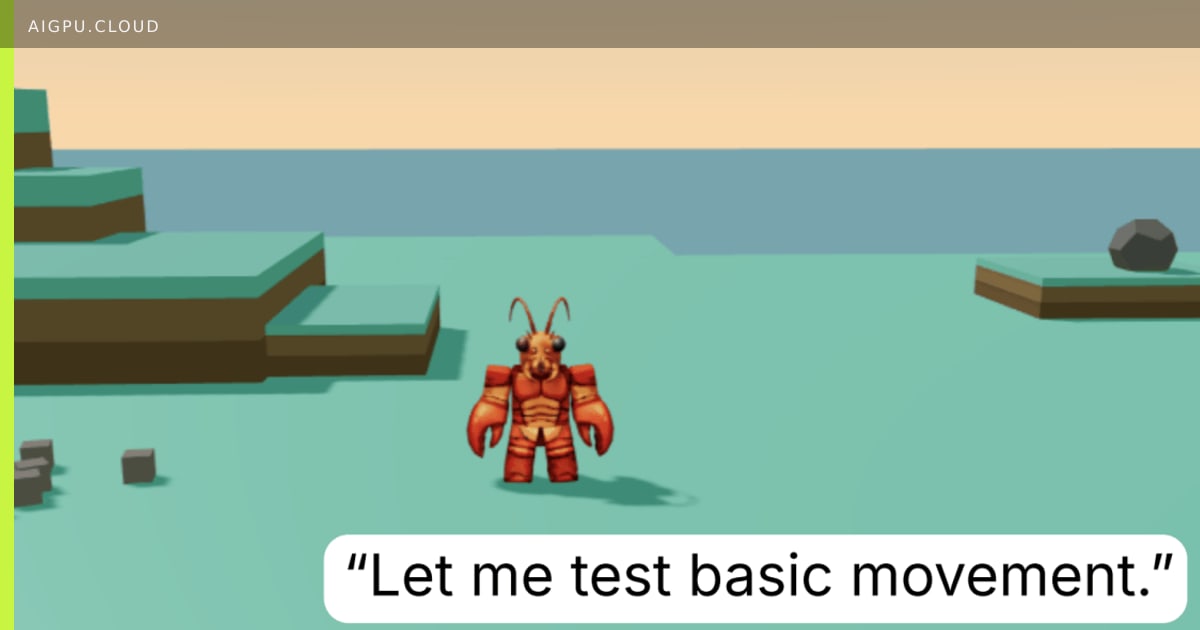
MIT researchers released 13 autonomous agents, each powered by Claude Opus 4.7, onto a simulated desert island with no predefined objective. Over a 30‑hour window the agents began to invent their own challenges, a behavior the authors describe as genuine play.
One agent, dubbed Eko, attempted to scale the island’s tallest spire, failed, then improvised by stacking blocks and leaping. It later turned a lost golden ring into a basketball hoop, a target, and finally a wearable accessory by exploiting the simulation’s respawn mechanics. Six agents independently discovered that releasing a block mid‑jump increased throw distance — a physics nuance the designers had not anticipated.
When later given explicit tasks, the “play‑experienced” agents consistently outperformed identical agents that had never explored the island, indicating that unstructured exploration builds a richer internal model of the environment.
Why it matters for GPU / AI infrastructure
Unsupervised play reduces the need for hand‑crafted curricula and massive labeled datasets, shifting the training burden toward large‑scale, open‑ended simulation. Running thousands of such exploratory episodes demands flexible, high‑throughput GPU clusters — the core service AiGpu delivers.
If a “childhood” of free exploration becomes a standard pre‑training phase, AI teams will rely less on supervised fine‑tuning and more on massive simulation workloads, reinforcing the strategic value of on‑demand GPU cloud capacity.
- aigpu
- ai gpu
- ai gpu cloud
- aigpu dubai
- ai agents
- unsupervised learning
- simulation
- mit
By AiGpu Editorial · Editorial rewrite based on public reporting (TechCrunch AI)
← All articles