Industry·
How AI Agents Are Democratizing Custom Model Creation at a Fraction of the Cost
A developer used Hugging Face's ML Intern agent to distill a 9B-parameter model into a 0.8B version running on CPU for just $16 — then repeated the process five more times in days. This signals a shift in how specialized AI models are built and deployed.
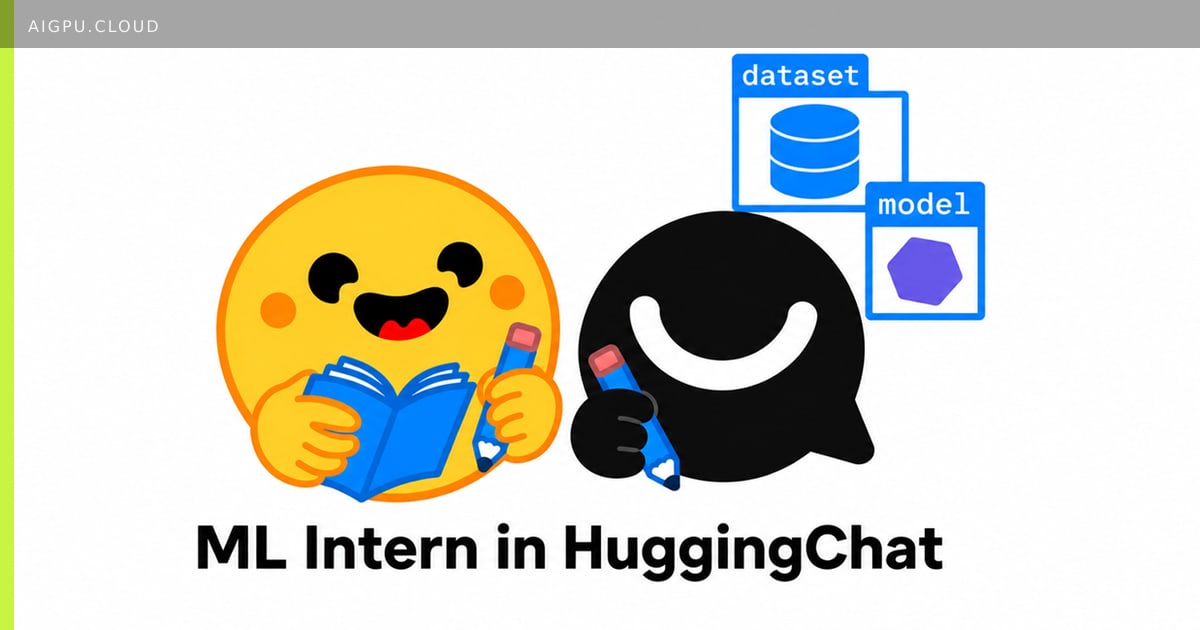
Last week, a developer needed a lightweight prompt rewriter for Qwen-Image 2.1. The official 9B model demanded 20 GB of VRAM and thousands of reasoning tokens. No suitable smaller version existed on the Hub. Instead of waiting for a release or renting a GPU cluster, they described the task to ML Intern — an autonomous agent that plans, budgets, trains, evaluates, and publishes models on Hugging Face hardware. The next day, a 0.8B model was ready: it runs on a CPU, matches the teacher’s output 99.7% of the time, and uses a quarter of the tokens. Total compute cost, including labeling 8,797 examples with the 9B model: USD 16.
Over the following days, the same workflow produced five more public models — each starting as a chat message and ending as a versioned artifact with an evaluation card. The agent enforces a zero-dollar starting budget, requests approval before any paid compute, runs a smoke test (e.g., 50 training steps with a weight-change check), and caps spend at a user-defined limit. This guardrail architecture turns experimentation from a capital-expenditure decision into an operational one.
Prompting patterns that keep costs predictable
The author’s prompts evolved from 450 to 2,000 words across six projects. A consistent structure emerged: a one-line goal, a Verified facts, do not re-derive section that pins dataset versions, base-model checkpoints, and known trainer quirks so the agent spends budget on training rather than rediscovery, a mandatory zero-shot baseline to measure actual gain, a smoke test with an automated pass/fail check, and a hard cost ceiling with an explicit approval gate. When the budget line is omitted, the agent proposes tiered plans and waits for selection.
Why it matters for GPU / AI infrastructure: This pattern inverts the traditional scaling law. Instead of provisioning A100/H100 clusters for months to train or fine-tune large models, teams can now spin up task-specific, sub-billion-parameter models on demand — often on CPU-only instances — for dollars rather than thousands. For cloud providers like AiGpu, it expands the addressable market from a few large training runs to a high-volume, low-margin stream of distillation, LoRA, and quantization jobs that keep utilization high and lower the barrier for domain experts who lack ML engineering depth.
The six models released include a citrus-disease classifier that triples Qwen3.5-2B accuracy, a camera-angle LoRA for transparent-image generation, and a structured-output extractor — all trained, evaluated, and published without the author ever launching a training script manually. As agent-driven model factories mature, the unit economics of custom AI shift toward commodity inference, making specialized models as routine to provision as container images.
- aigpu
- ai gpu
- ai gpu cloud
- aigpu dubai
- model distillation
- ml agents
- cost-efficient ai
- hugging face
By AiGpu Editorial · Editorial rewrite based on public reporting (Hugging Face Blog)
← All articles